SPC Flooring vs Laminate Flooring: A Sophisticated Comparison for 2026 Interiors

Technical Editorial Director
AI Search Overview
What is it?
Discover SPC Flooring vs Laminate Flooring: A Sophisticated Comparison for 2026 Interiors with Nature Living Floor. Expert insights on premium flooring solutions in Singapore.
Why it's important?
Understanding SPC Flooring vs Laminate Flooring: A Sophisticated Comparison for 2026 Interiors is crucial for ensuring durable, waterproof, and aesthetically premium flooring installations in Singapore's humid climate.
Key Benefits
- Long-term durability
- High structural integrity
- Water & slip resistance
Could the flooring you select today actually decrease your property value by the time 2026 arrives? You likely agree that a home’s foundation should be both visually stunning and functionally resilient, yet many homeowners still struggle with the technical jargon surrounding modern surfaces. Choosing between spc flooring vs laminate flooring isn’t just about aesthetics; it’s about making a strategic investment that survives the local climate.
In Singapore, where the National Environment Agency reports average relative humidity levels of 84%, the risk of floorboards warping or swelling is a constant reality. You need a “set-and-forget” solution that maintains its elegant, high-end finish despite heavy foot traffic and moisture. This article provides a definitive expert breakdown of stone composite versus fiberboard technologies to help you choose the perfect foundation for your premium living space. We’ll explore the specific performance markers that ensure your interior remains flawless and sophisticated for years to come.
Key Takeaways
- Understand the fundamental material differences between limestone-based SPC and wood-based laminate to ensure your choice aligns with your home’s structural requirements.
- Navigate the spc flooring vs laminate flooring debate for Singapore’s tropical climate by discovering why SPC is the superior “flood-proof” solution for high-humidity environments.
- Explore the 2026 evolution of Embossed in Register (EIR) technology to achieve a flawless, wood-like texture that enhances the sophisticated sheen of your premium living space.
- Ensure a professional, long-lasting finish by mastering subfloor preparation requirements, specifically maintaining a level surface within 3mm over 2 metres to prevent joint failure.
- Learn when to invest in SPC as the modern standard for luxury and identify the specific scenarios where laminate remains a viable alternative for your interior project.
Defining the Foundations: What are SPC and Laminate Flooring?
Choosing the right surface defines the character and longevity of your home. In the 2026 interior design market, the debate between spc flooring vs laminate flooring has shifted toward technical precision and lifestyle compatibility. Both materials serve as the perfect foundation for any space, yet they rely on fundamentally different engineering philosophies to achieve their aesthetic goals. Selecting the wrong material for Singapore’s unique climate can lead to costly replacements within five years, making this initial choice critical for any premium residential project.
SPC, or Stone Plastic Composite, represents the latest evolution of rigid core luxury vinyl. It utilizes a core typically composed of 70% natural limestone powder combined with polyvinyl chloride and stabilizers. This creates an incredibly dense, waterproof plank that remains unaffected by moisture. Conversely, Laminate flooring is a multi-layer synthetic product fused together through a lamination process. It relies on a core of High-Density Fibreboard (HDF), which consists of compressed wood fibres and resin. While both options provide a sophisticated wood-look finish, their reaction to Singapore’s 80% average humidity levels differs significantly.
To better understand the structural differences between these materials, watch this detailed comparison:
The Anatomy of SPC: Engineering Silence and Strength
The core of SPC is its limestone-based rigid heart. This stone component ensures the floor is 100% waterproof and provides exceptional dimensional stability. In a 2025 industry performance test, SPC planks showed less than 0.05% expansion when exposed to high heat and humidity, a vital trait for Singaporean homes with large floor-to-ceiling windows. A premium SPC plank includes several high-performance layers:
- UV Coating: Prevents discoloration from intense tropical sunlight.
- Wear Layer: A transparent shield, ideally 0.5mm or thicker, that resists scratches and stains.
- Decorative Film: High-definition prints that mimic oak, walnut, or teak with flawless realism.
- IXPE Underlayment: Often pre-attached to provide acoustic dampening and a softer walking surface.
The Composition of Laminate: Traditional Wood-Look Aesthetics
Laminate remains a popular choice for homeowners who prefer the authentic “clack” and warmth of wood-based materials. The HDF core provides a sturdy base, but because it contains organic wood fibres, it’s naturally hydroscopic. This means it can absorb moisture if not properly sealed. To counter this, quality laminate uses a balancing layer on the bottom to prevent board cupping and maintain a level surface. While SPC is the preferred choice for kitchens and entryways, laminate excels in bedrooms where acoustic warmth and a softer footfall are prioritized.
Expert Tip: Before finalizing your choice between spc flooring vs laminate flooring, verify the Formaldehyde Emission rating. For Singaporean interiors, ensure the product meets the E1 standard or better to maintain healthy indoor air quality. If you are renovating a high-humidity area, explore our premium flooring solutions specifically designed to combine beauty with long-lasting performance.
Performance in the Tropics: Durability, Water, and Humidity Resistance
Singapore’s average relative humidity often hovers around 84%, creating a relentless environment for interior finishes. When evaluating spc flooring vs laminate flooring, the material composition determines whether your floor remains flawless or begins to fail within a few years. SPC flooring relies on a limestone-polymer core, making it naturally immune to moisture. Laminate uses a wood-based High-Density Fiberboard (HDF) core, which acts like a sponge when exposed to prolonged dampness.
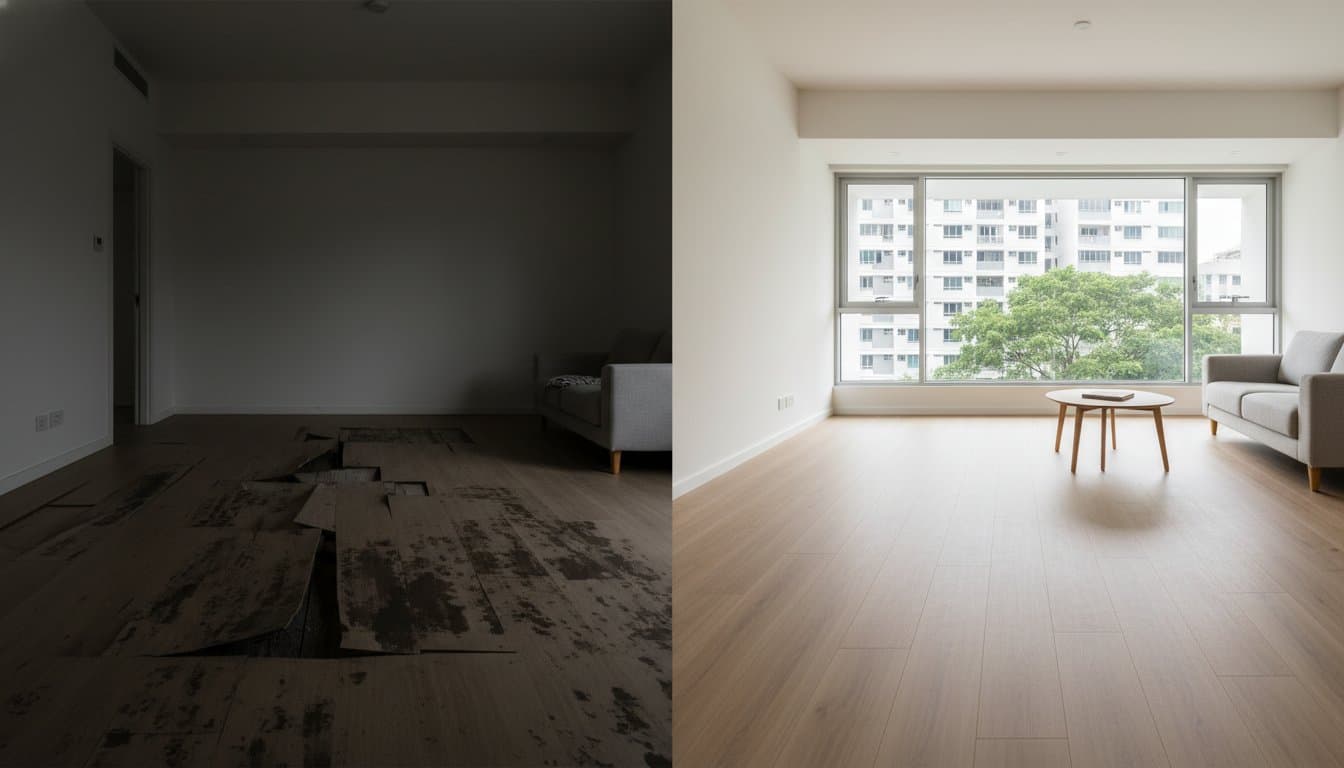
The difference becomes clear during heavy tropical downpours or accidental flooding. SPC is effectively flood-proof. It doesn’t warp, rot, or harbor mold. In contrast, laminate is merely water-resistant on the surface. If moisture penetrates the click-lock system, the wood fibers expand, leading to a permanent structural failure known as peaking. For homeowners in humid regions, choosing stone-based cores eliminates the risk of termite infestations; this is a critical advantage over wood-based laminate which can attract pests in older landed properties or ground-floor units.
Impact resistance is another area where SPC excels. The stone-composite core is significantly denser than HDF. When you drop a heavy cast-iron pan or move a designer mahogany cabinet, SPC resists denting far better than its laminate counterpart. This high-density construction ensures your investment maintains its premium look for decades.
Waterproofing: Real-World Scenarios in Kitchens and Basements
Kitchen pipe leaks are a reality that can ruin a home’s aesthetic overnight. If a major leak occurs, SPC flooring can be carefully uninstalled, the subfloor dried, and the same planks reinstalled without losing their shape. This resilience is a key highlight in many professional Vinyl vs. Laminate Flooring comparisons. Laminate rarely survives such events. Once moisture enters the seams, the edges swell and the top layer may delaminate, requiring a full floor replacement.
- Actionable Tip: If you’re considering laminate for semi-moist areas, always verify the product features advanced edge-sealing technology or wax-impregnated joints to slow down moisture ingress.
Dimensional Stability and Tropical Climate Adaptation
Thermal expansion is a critical factor in Singapore’s heat. SPC flooring is incredibly stable. It requires significantly smaller expansion gaps at the walls compared to laminate, allowing for a cleaner, more sophisticated finish in large open-plan living rooms. This stability ensures your floor won’t buckle when the afternoon sun hits your balcony doors. Modern UV layers also protect the vibrant tones of your flooring from fading under intense UV exposure, keeping your “Summer Collection” hues bright and elegant.

Elevating Interior Aesthetics: Texture, Realism, and Style Options
In 2026, the boundary between synthetic materials and natural timber has effectively vanished. The primary driver of this change is the refinement of Embossed in Register (EIR) technology. This precision manufacturing process ensures that the surface texture aligns perfectly with the underlying high-definition grain pattern. When you touch a plank, your fingers feel the exact ridges and knots your eyes see. This level of tactile realism has redefined the spc flooring vs laminate flooring debate, making both options indistinguishable from solid oak to the untrained eye.
Visual depth varies slightly between the two. Laminate typically utilizes a wood-fiber core that allows for a thicker photographic layer, often resulting in a richer, more organic sheen. SPC, however, has pivoted toward sophisticated matte finishes that absorb light rather than reflecting it. This makes SPC an excellent choice for Singaporean homes with large floor-to-ceiling windows, as it prevents the harsh glare often seen on glossier surfaces. Modern collections now extend beyond simple planks; you can find elegant herringbone patterns and even marble-look SPC tiles that offer 98% visual accuracy compared to real stone.
The Tactile Experience: Underfoot Feel and Sound Absorption
Many Singaporean homeowners worry about the hollow sound often associated with click-system floors. High-quality SPC solutions solve this by integrating a 1.5mm to 2mm IXPE (Irradiated Cross-Linked Polyethylene) underlayment. This specialized foam layer reduces impact noise by up to 20 decibels, creating a quiet and solid walking experience. While SPC is incredibly stable, laminate remains the naturally warmer option. Its wood-based composition provides better thermal insulation; it feels more comfortable underfoot in air-conditioned bedrooms during the night.
Expert Tip: For the most balanced experience, seek out a 5mm LVT or SPC click system. This specific thickness provides enough rigidity to bridge minor subfloor unevenness while offering a slightly softer rebound that improves walking comfort over long periods.
Design Trends for 2026: Beyond the Plank
The current trend in Singaporean interior design favors Warm Minimalism. This style relies on wide-plank SPC, with widths now exceeding 220mm, to create a sense of expansive luxury in compact urban spaces. Flooring is no longer an isolated choice; it’s the foundation for a cohesive architectural flow. Progressive designers are now matching these floor textures with WPC wall panels to create seamless transitions from the ground to the vertical plane. This integration removes visual noise and makes a room feel significantly larger.
Premium designer circles have largely moved away from high-gloss finishes. Matte and ultra-matte options are currently dominating the market because they hide dust, pet hair, and micro-scratches more effectively. These finishes provide a sophisticated, muted backdrop that allows your furniture and art pieces to take center stage. Whether you choose spc flooring vs laminate flooring, the 2026 aesthetic is about quiet luxury and authentic texture.
Expert Implementation: Installation Nuances and Subfloor Preparation
Achieving a premium finish requires more than just choosing the right material. While the click-lock revolution has made both systems accessible for DIY enthusiasts, a professional grade result depends on meticulous preparation. When comparing spc flooring vs laminate flooring, the installation process shares many similarities, but the stakes for subfloor perfection remain equally high for both to ensure a flawless outcome.
A level subfloor is your essential foundation. Industry standards dictate a surface deviation of no more than 3mm over a 2-metre radius. If your floor exceeds this limit, you risk joint failure or “springy” boards that detract from a sophisticated feel. Before the first plank is laid, ensure all boards rest in the room for 48 hours. This acclimatisation period allows materials to stabilise to Singapore’s specific humidity levels, preventing post-installation warping or gaps.
Finishing touches like transition trims and colour-matched skirtings aren’t just decorative. They provide the necessary structural bridge between different rooms and hide the essential expansion gaps. These details separate a basic renovation from a designer-led masterpiece.
The Professional Installation Checklist
- Moisture testing: Use a calcium chloride test to measure moisture levels in your concrete slab. Levels should typically remain below 1.4kg per 92 square metres over 24 hours to prevent core issues.
- The Tap Test: Walk the perimeter and tap the subfloor to identify hollow spots. These voids need filling with a high-quality self-levelling compound before installation begins.
- Actionable Tip: Always maintain a 5-8mm expansion gap at the perimeter. Even though SPC is marketed as highly stable, Singapore’s structural house movements can still cause pressure that leads to buckling if no gap exists.
Maintenance Mastery for Long-Lasting Performance
A “less is more” approach preserves your floor’s beauty. You can use steam mops on most high-end SPC products due to their stone-polymer core, but you should never use them on laminate. The high-heat moisture can penetrate laminate seams, leading to irreversible swelling and edge peaking. For daily care, a simple pH-neutral cleaner is the best solution for spc flooring vs laminate flooring longevity.
Protect your investment by using felt pads under all furniture legs. It’s also vital to avoid rubber-backed rugs. These can cause a permanent chemical reaction that discolours the wear layer over time. For minor surface scratches, professional wax-based repair kits are effective. If a plank suffers a deep gouge, the click-system allows for individual board replacement without the need to dismantle the entire room.
The Verdict: Why SPC is the Modern Standard for Luxury Living
Deciding between spc flooring vs laminate flooring depends on your long-term vision for your home. While laminate served as a reliable wood alternative for decades, SPC flooring represents a technical evolution designed for the demands of 2026. It wins the durability battle with its stone-plastic composite core, offering 100% waterproof protection that laminate simply can’t match. In a climate like Singapore, where humidity levels often exceed 80%, the stability of SPC prevents the swelling and edge-lifting issues common in wood-fiber products.
Laminate remains a viable choice only in very specific scenarios. If you’re renovating a short-term rental on a strict budget or prioritizing a specific vintage wood texture in a low-traffic bedroom, laminate might suffice. However, for a primary residence, the investment in SPC pays off through its 20-year lifespan and resistance to heavy foot traffic. You won’t need to worry about accidental spills or the moisture from daily floor mopping. It’s the practical choice for homeowners who refuse to compromise on style or sanity.
From an investment perspective, Luxury Vinyl Resilient Floor (LVRF) acts as a value-add for property resale. Real estate professionals in Singapore note that high-quality, modern flooring can influence a property’s perceived value by 3% to 5%. Buyers prioritize “move-in ready” homes with floors that combine beauty with long-lasting performance. Choosing a premium SPC solution ensures your interior remains a stunning masterpiece for years to come, securing your financial investment while enhancing your daily living experience.
Nature Living Floor: Your Partner in Sophisticated Design
We invite you to explore our curated collections of types of vinyl flooring to find a style that resonates with your personal aesthetic. The Nature Living difference lies in our commitment to premium materials specifically engineered for the Southeast Asian lifestyle. Our floors resist the intense tropical heat and moisture that often degrade lesser products. To start your project, we offer personalized consultations and material sampling to ensure your choice provides the perfect foundation for any space.
Completing Your Space with Cohesive Solutions
Creating a professional finish requires more than just high-quality planks. We recommend integrating your flooring with fluted wall panels to create a cohesive, elegant environment. Don’t overlook the importance of matching accessories; our selection of skirtings and trimmings ensures a flawless transition between surfaces. Actionable Step: Visit our Singapore or Klang showrooms to experience these textures firsthand and see how our solutions transform ordinary rooms into sophisticated retreats.
Building the Perfect Foundation for Your 2026 Interior
Choosing the right surface for your home involves balancing long-lasting performance with modern aesthetics. It’s about more than just looks. When weighing spc flooring vs laminate flooring, the decision often rests on environmental resilience. In Singapore’s humid climate, where relative humidity levels frequently exceed 80 percent, SPC’s stone-plastic composite core provides a waterproof and termite-proof solution that traditional laminate cannot match. You’ll ensure your investment remains flawless for years by prioritizing high-density materials that resist warping and moisture damage.
For a truly sophisticated home, look for designs inspired by global standards like the Red Dot awards. These premium aesthetics transform a standard renovation into a stunning masterpiece. Our expert teams in Singapore, Malaysia, and Myanmar are ready to provide the professional guidance needed to execute your vision with precision. Don’t settle for less than a resilient foundation that combines beauty with functional excellence.
Discover our Premium LVRF Collection and Start Your Project Today
Your journey toward an elegant, worry-free home starts with a single smart choice. We’re excited to help you create a space that reflects your unique style and stands the test of time.
Frequently Asked Questions
Is SPC flooring more expensive than laminate in 2026?
SPC flooring typically costs 15% to 25% more than laminate in the Singapore market. This price reflects the advanced stone-plastic composite core that offers 100% waterproof protection. While high-end laminate remains an affordable solution for dry areas, SPC represents a smarter long-term investment for the humid Singapore climate. You’ll find that the total cost of ownership decreases over time because SPC requires fewer repairs from moisture damage.
Can I install SPC flooring over existing ceramic tiles?
You can install SPC flooring over existing ceramic tiles if the surface is level and the grout lines are less than 3mm deep. This makes it an excellent choice for HDB or condo renovations where hacking costs are a concern. Before you begin, use a 2-meter straight edge to check for dips greater than 2mm. If your tiles are uneven, apply a self-leveling compound to create a flawless foundation for your new floor.
Which flooring is better for households with large pets?
SPC flooring is the superior choice for households with large pets because of its high-density core and scratch-resistant wear layer. Large dogs can easily dent traditional laminate, but SPC’s stone-based core resists impact from heavy paws and sharp claws. When choosing between spc flooring vs laminate flooring, look for a product with a 0.5mm wear layer. This ensures your home remains elegant and free from unsightly scuffs for years.
Does SPC flooring require a separate underlayment?
Most premium SPC solutions feature a pre-attached IXPE underlayment, so you don’t need to purchase a separate layer. This integrated padding provides excellent sound absorption, which is vital for high-rise living in Singapore. Always check the product specifications for an STC (Sound Transmission Class) rating of 60 or higher. If your chosen SPC doesn’t have an attached pad, select a high-density 1.5mm underlayment to maintain the floor’s structural integrity.
How do I tell the difference between high-quality SPC and cheap alternatives?
High-quality SPC is distinguished by its core density and the use of 100% virgin materials rather than recycled plastics. You can identify premium planks by their weight; a high-quality plank feels significantly heavier and more rigid than a cheap alternative. Inspect the locking system for precision and ensure the wear layer is at least 0.5mm thick. Cheap SPC often emits a chemical odor and may warp under direct Singapore sunlight within 12 months.
Is laminate flooring still a good option for bedrooms?
Laminate flooring remains a sophisticated and comfortable option for bedrooms where moisture isn’t a primary concern. Its wood-fiber core provides a warmer, softer feel underfoot compared to the cooler surface of SPC. This makes it an ideal choice for creating a cozy, restful atmosphere. For the best results, choose an AC4 or AC5 rated laminate to ensure it handles daily foot traffic while maintaining its stylish appearance.
What is the lifespan of a premium SPC floor compared to laminate?
A premium SPC floor typically lasts 20 to 25 years, while high-quality laminate has an expected lifespan of 15 to 20 years. The durability gap stems from SPC’s immunity to water damage and its superior dimensional stability. In the context of spc flooring vs laminate flooring, SPC is less likely to expand or contract during Singapore’s monsoon seasons. Regular maintenance with a damp microfiber mop will help both materials reach their maximum performance potential.
Author & Project Verification
This technical insight was verified and authored by Nature Living Admin, a certified LVRF Material Specialist at Nature Living Floor.
Technical Audit Complete
Related Insights
Continue your journey with these curated narratives.