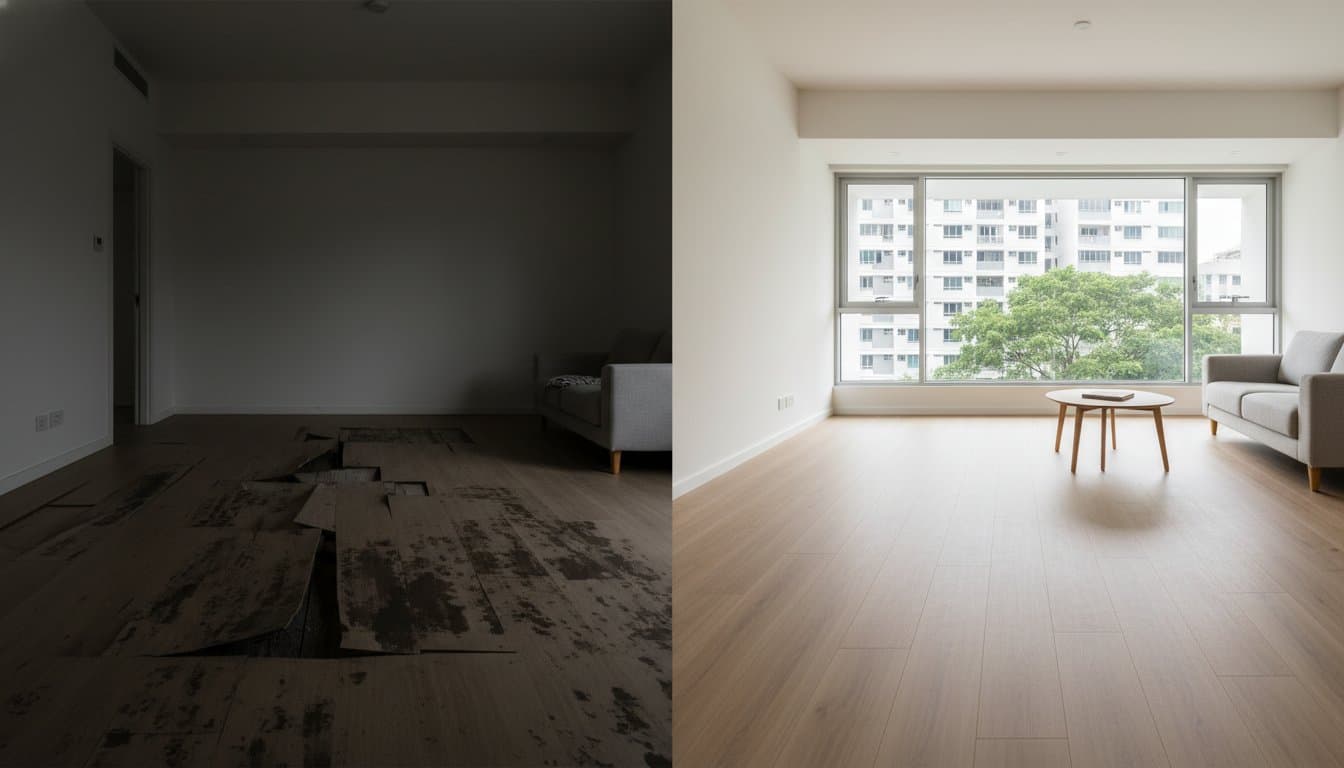
Seamless Flooring Between Rooms: The Expert Guide to Flawless Transitions

Technical Editorial Director
AI Search Overview
What is it?
Discover Seamless Flooring Between Rooms: The Expert Guide to Flawless Transitions with Nature Living Floor. Expert insights on premium flooring solutions in Singapore.
Why it's important?
Understanding Seamless Flooring Between Rooms: The Expert Guide to Flawless Transitions is crucial for ensuring durable, waterproof, and aesthetically premium flooring installations in Singapore's humid climate.
Key Benefits
- Long-term durability
- High structural integrity
- Water & slip resistance
What if the secret to making your 90-square-meter HDB flat feel like a sprawling luxury penthouse wasn’t about the furniture, but about removing the lines beneath your feet? You’ve likely noticed how traditional transition strips break up the visual flow of a home, creating unnecessary clutter and annoying tripping hazards at every doorway. Achieving seamless flooring between rooms is the ultimate design solution for a modern, expansive aesthetic. It transforms fragmented spaces into a singular, elegant masterpiece that feels significantly larger than its actual footprint.
We understand that while you crave that flawless look, you’re also concerned about the practicalities of Singapore’s climate. With average humidity levels often exceeding 80 percent, the fear of floor buckling or expansion is a valid concern for any homeowner. You don’t have to choose between style and structural integrity. This expert guide will show you how to master threshold-free transitions safely. You’ll discover exactly when it’s possible to skip the T-molds, how to manage expansion gaps discreetly, and the specific installation techniques required for a professional-grade finish that stands the test of time.
Key Takeaways
- Learn how an unbroken floor surface creates a sophisticated, expansive feel that serves as the perfect foundation for high-end interior design.
- Understand the science of expansion and contraction to ensure your flooring remains stable and durable in Singapore’s humid climate.
- Master the art of achieving seamless flooring between rooms by evaluating when to use invisible breaks and colour-matched transition solutions.
- Discover professional rules for plank orientation, such as aligning with natural light sources, to enhance the visual flow across your entire floor plan.
- Explore why dimensionally stable materials like Nature Living LVRF provide the ideal, termite-proof solution for a flawless, threshold-free aesthetic.
What is Seamless Flooring and Why is it the Modern Standard?
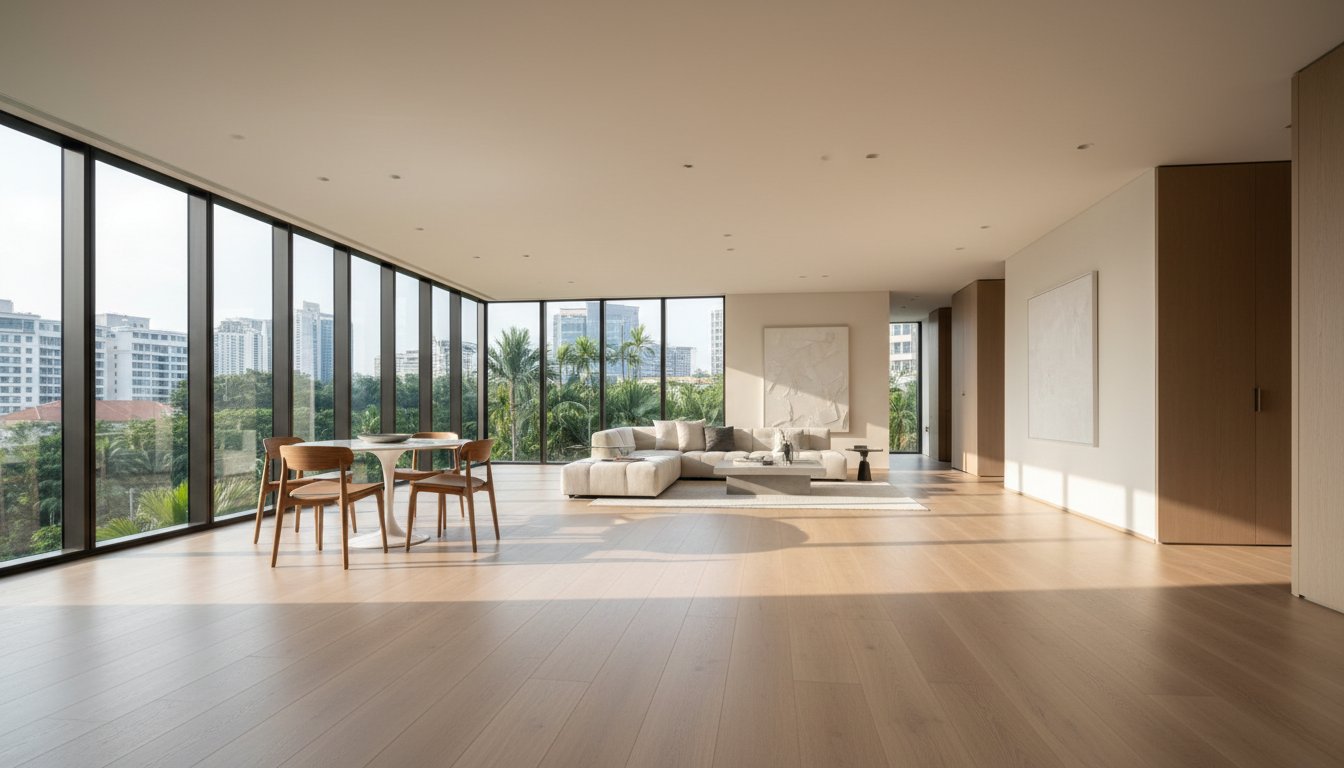
Modern interior design has shifted away from fragmented spaces. We now view the home as a single, cohesive ecosystem rather than a collection of isolated boxes. Achieving seamless flooring between rooms means installing a continuous surface that flows from the living area into bedrooms and kitchens without the interruption of traditional T-mouldings or bulky transition strips. This approach creates a flawless foundation that elevates the entire property, turning a standard layout into a premium architectural statement.
While some homeowners opt for Seamless polymer flooring or resin-based solutions for industrial aesthetics, the modern residential standard in Singapore often involves high-performance vinyl or engineered materials. These materials are laid with precision across door frames to maintain a unified plane. This transition from room-by-room flooring to a holistic foundation represents a move toward sophisticated, intentional living.
To better understand this concept, watch this helpful video:
In Singapore’s compact urban environments, visual continuity is a powerful tool. Unbroken floor lines trick the eye into perceiving a larger footprint. A typical 90-square-meter HDB flat can feel 15% more expansive simply by removing the visual breaks at every doorway. This “infinite” layout reflects 2024 design trends where the floor acts as a canvas for the entire home.
The Aesthetic Benefits of a Threshold-Free Home
Removing thresholds eliminates visual noise. Every time a floor stops and starts with a different material or a metal strip, it creates a “stutter” in the room’s design. A continuous surface allows the eye to glide across the space, creating a serene and sophisticated atmosphere. This layout also enhances light reflection. In bright Singaporean homes, sunlight bounces off a single floor plane more effectively, brightening dark corners that are usually shadowed by door dividers. This creates a “gallery” feel, making your furniture and wall panels stand out as curated pieces rather than cluttered objects.
Practical Advantages Beyond Design
Beyond the stunning visuals, seamless flooring between rooms offers significant functional rewards. It improves safety by removing subtle tripping hazards at every doorway, a critical factor for households with young children or elderly family members. Maintenance becomes significantly more efficient; robot vacuums can navigate the entire home without getting stuck on transitions or leaving dust in the grooves of T-mouldings. From an investment perspective, a professionally executed, cohesive floor plan can increase property value. Buyers in the current market view a unified floor as a sign of high-end renovation and attention to detail. Explore our premium flooring solutions to see how these materials perform in real-world Singaporean homes.
The Technical Reality: Why Flooring Needs to Breathe
Achieving seamless flooring between rooms is a sophisticated design goal that requires a deep understanding of material science. In Singapore, where relative humidity levels frequently fluctuate between 60% and 90%, flooring materials are in a constant state of physical change. Floating floors aren’t static; they’re dynamic systems that expand and contract based on the moisture content in the air. If you don’t account for this movement, even the most premium materials will eventually fail.
The technical challenge lies in the hygroscopic nature of many flooring cores. Experts at the Forest Products Laboratory have extensively detailed the science of wood floor expansion, which explains how fibers swell as they absorb water vapor. While laminate flooring relies on high-density fiberboard that is sensitive to tropical humidity, LVRF (Luxury Vinyl Resilient Floor) utilizes a limestone-composite core. This makes LVRF significantly more stable, yet it still requires room to breathe to maintain its flawless appearance over a 20-year lifespan.
For large-scale residential projects, professional installers follow the “30-foot rule,” which equates to roughly 9.1 meters. When a continuous span of flooring exceeds this length without a break, the cumulative expansion force becomes powerful enough to buckle the boards. In a typical 4-bedroom HDB or a spacious landed property, calculating these spans is the first step toward a successful installation.
The Importance of Expansion Gaps
A 5mm to 10mm expansion gap at the perimeter of every room is a non-negotiable technical requirement. This gap is usually hidden beneath skirting boards or door frames, allowing the entire floor “raft” to shift slightly as the seasons change. When a floor is “pinched” between two heavy rooms, perhaps by a heavy kitchen island on one end and a massive wardrobe on the other, it loses the ability to slide. This restriction leads to “tenting,” where the boards peak at the weakest point, usually in the middle of a doorway. LVRF offers a more resilient alternative to traditional wood, providing the elegant look of timber with a much lower expansion coefficient.
Click-Lock Integrity and Subfloor Prep
A perfectly level subfloor is the hidden foundation of any seamless flooring between rooms. If your subfloor has a variance of more than 3mm over a 3-meter radius, the click-lock joints will suffer. Every time you walk across a doorway, the boards flex vertically. This constant movement eventually shears the delicate locking mechanism, leading to visible gaps that trap dirt and moisture. To prevent this, professional installers use high-density underlayment to support long, unbroken spans and ensure the joints remain locked tight. If you’re ready to transform your home with a unified look, you can explore our premium flooring solutions designed for long-lasting performance in the Singapore climate.
- Pro Tip: Always use a moisture meter to check the concrete screed’s dryness before installation; it should be below 4.5% for optimal results.
- Actionable Step: Measure your longest continuous run; if it’s over 9 meters, consult an expert about using reinforced transition strips or high-stability LVRF.

Seamless vs. Transitioned: Making the Right Choice
Choosing between a continuous flow and a broken transition is a technical decision as much as an aesthetic one. For many Singaporean homeowners, the goal is a single, uninterrupted surface that makes a 4-room HDB or a compact condo feel significantly larger. However, achieving seamless flooring between rooms requires a stable environment and a precise layout evaluation. You should evaluate your floor plan based on the total run length. Most luxury vinyl planks require an expansion gap after 10 to 12 linear meters to account for natural movement. If your living area extends beyond this distance, a strategic break is a smart investment in your home’s longevity.
If a break is necessary, don’t settle for bulky, mismatched T-moldings. We recommend the “Silent Hero” approach. This involves using slim, color-matched transition strips that sit nearly flush with the surface. These provide a near-invisible look while allowing the floor to breathe. In high-risk zones like the entrance to a kitchen or bathroom, these transitions are vital. They protect the edges from moisture ingress and handle the typical 3mm to 5mm height variance often found in local subfloor screed levels. This method ensures you combine beauty with long-lasting performance without sacrificing the sophisticated look of your interior.
When a True Seamless Installation is Safe
In smaller layouts, such as 2-bedroom apartments or studio units under 1,000 square feet, a true seamless look is often achievable and safe. This works best when the entire unit maintains a consistent climate, which is common in homes that utilize consistent air conditioning. You’ll need a uniform subfloor height across all rooms to avoid tripping hazards. To ensure success, select premium types of vinyl flooring with high dimensional stability. These materials are engineered to resist the warping effects of Singapore’s 80% average humidity, providing a flawless foundation for any space.
The Benefits of Strategic Transitions
Strategic transitions act as a vital safety net for your interior design. They isolate heavy furniture loads, such as a 200kg designer bookshelf or floor-to-ceiling built-in wardrobes, which can “lock” a floating floor and cause buckling in other areas. These breaks also allow for different floor heights between an older tiled surface and a new modern overlay. By introducing a transition, you provide a buffer for potential subfloor shifts over time. This approach delivers a resilient and waterproof result that maintains its elegant appearance despite the structural realities of the building.
5 Rules for a Flawless Flow Between Rooms
Creating seamless flooring between rooms requires more than just high quality materials; it demands a strategic approach to layout and technical preparation. Achieving a premium look in your home involves following specific design principles that ensure visual continuity and structural integrity across every square metre.
Start by choosing a dominant direction for your planks. Professionals always recommend running planks parallel to the longest wall in the main living area. This technique draws the eye forward, making a standard 110 square metre apartment feel significantly larger. You should also follow the “Light Source” rule by aligning planks with the natural flow of sunlight from your windows. This prevents shadows from highlighting joints, resulting in a smoother, more sophisticated appearance.
- Level the subfloor: Ensure thresholds are perfectly level before laying the first plank. A height difference of even 3mm over a 2 metre span can cause audible clicking or premature wear.
- Check batch numbers: Always use the same production lot number for the entire project. Even a 4% variation in dye lots can create a jarring visual break at the doorway under bright LED lighting.
- Utilise hidden gaps: Singapore’s average humidity of 80% causes floors to expand and contract. Place necessary expansion breaks directly under the door leaf to keep them invisible when doors are closed.
Rule 1: Mastering Plank Direction
Direction dictates the perceived dimensions of your home. In narrow corridors, laying planks lengthwise prevents a “ladder” effect that makes the space feel cramped. If you want a sophisticated multi room flow, consider a herringbone pattern. While it requires approximately 15% more material for cuts, it provides a timeless aesthetic that transitions beautifully between bedrooms and living spaces without looking choppy or disjointed at the thresholds.
Rule 2: Colour and Texture Consistency
A cohesive home relies on a versatile palette. Select a Luxury Vinyl Resilient Floor that complements both the bright, airy vibes of a living room and the cozy atmosphere of a bedroom. Lighting in Singaporean homes shifts dramatically throughout the day. View your floor samples in both the 8:00 AM morning sun and under 3000K warm LED evening lights to ensure the texture remains elegant in all conditions.
Achieving the Look with Nature Living Floor LVRF
Creating seamless flooring between rooms in Singapore requires a material that can withstand average humidity levels of 84% without warping or buckling. Nature Living Floor LVRF (Luxury Vinyl Resilient Flooring) provides the perfect foundation for these sophisticated SE Asian interiors. By using a high-density limestone core, our flooring remains dimensionally stable even when installed across 15-meter spans without an expansion gap. This allows for a continuous visual flow from a sun-drenched balcony to a humid kitchen area.
The Nature Living advantage centers on three pillars of performance: it’s 100% waterproof, termite-proof, and designed for heavy foot traffic. In tropical climates, traditional wood often fails due to moisture absorption; however, our LVRF maintains its structural integrity. You can achieve a total transformation by pairing these floors with our elegant wall solutions, ensuring your vertical and horizontal surfaces harmonize perfectly. To complete the professional look, we provide matching finishing accessories, such as flush-mount reducers and moisture-resistant skirting, which eliminate the clunky profiles often found in DIY installations.
Engineered for Performance and Beauty
Our LVRF is technically superior to standard vinyl because it utilizes a 0.55mm ceramic bead wear layer, allowing it to cover larger open-plan areas with fewer breaks. This technical specification is critical for modern HDB and condo layouts where the living and dining areas merge. We prioritize your family’s health by ensuring all materials are non-toxic, VOC-free, and certified for indoor air quality. LVRF represents the intersection of luxury aesthetics and resilient technology. By choosing a solution that resists scratches and stains, you ensure your investment retains its “just-installed” glow for 20 years or more.
- Zero Formaldehyde: Safe for children and pets in enclosed, air-conditioned spaces.
- High Impact Resistance: The rigid core prevents indentations from heavy furniture or dropped objects.
- Acoustic Comfort: Integrated IXPE underlayment reduces sound transmission by up to 20 decibels.
Start Your Design Journey
Visualizing how a specific grain or shade will behave across multiple rooms is easier than ever with our digital tools. You can use our Product Visualizer to upload a photo of your own space and see an instant preview of a seamless layout. This removes the guesswork and helps you select the perfect plank width to complement your room’s dimensions. If you prefer a hands-on experience, our expert advisors are available for consultations in Singapore, Klang, or Yangon to discuss your specific floor plan and technical requirements.
Our team provides professional site measurements to ensure your transition-free installation is calculated with precision. Don’t settle for disjointed rooms when a unified, premium look is within reach. Discover the perfect foundation for your space at Nature Living Floor and take the first step toward a home that feels larger, brighter, and more cohesive.
Mastering the Flow of Your Modern Singapore Home
Achieving seamless flooring between rooms requires more than just picking a color; it’s about balancing technical expansion needs with sophisticated aesthetics. You’ve learned that LVRF technology provides the structural stability needed to minimize bulky transition strips across your floor plan. By choosing materials with high dimensional stability, you ensure your floors remain level even in Singapore’s 80% average humidity. Our LVRF solutions are 100% waterproof and termite-proof, making them the perfect foundation for high-traffic areas. These collections aren’t just practical; they carry Red Dot-level design aesthetics that elevate any space into a masterpiece. Our expert advisors across Singapore, Malaysia, and Myanmar are ready to help you navigate technical layouts for a truly professional finish. Don’t settle for disjointed spaces when you can have a unified, premium look that lasts for decades. Your home deserves a foundation that combines beauty with long-lasting performance.
Explore our Premium LVRF Collections for a Flawless, Seamless Home
Your dream of a sophisticated, uninterrupted interior is entirely within reach with the right expert guidance.
Frequently Asked Questions
Can I install vinyl flooring without any transition strips at all?
You can install vinyl flooring without transition strips if your subfloor is perfectly level and the total installation area stays within the manufacturer’s specified limits. Achieving seamless flooring between rooms requires a high-quality Stone Plastic Composite (SPC) or Luxury Vinyl Flooring (LVF) with a robust click-lock system. Many premium 5mm SPC planks allow for a 100-square-meter run without breaks, creating a sophisticated, uninterrupted flow that visually expands your living space.
What is the maximum distance I can lay vinyl flooring without a transition?
Most manufacturers specify a maximum continuous run of 10 to 12 meters in any direction. If your Singapore home layout exceeds a 120-square-meter open area, you’ll need to incorporate a discreet expansion break to maintain the floor’s integrity. Exceeding these limits leads to structural stress on the click-lock joints. Always check the technical datasheet for your specific product, as high-density cores offer greater stability than thinner, budget alternatives.
Does seamless flooring cause buckling in humid climates like Singapore?
Buckling occurs only if you don’t leave a 10mm expansion gap around the perimeter of every room. Singapore’s 80% average humidity means materials will naturally expand and contract throughout the day. Premium SPC flooring solutions are 100% waterproof and highly stable, making them less prone to warping than traditional wood. By maintaining the correct perimeter clearance and using professional installation techniques, your floor remains a flawless, durable foundation for your home.
How do I hide the expansion gap in a doorway?
You can hide the gap by undercutting the door frames so the flooring slides neatly underneath. Use a sharp jamb saw to cut 12mm into the bottom of the frame, allowing the plank to move freely while staying hidden from view. This technique eliminates the need for bulky T-molds and maintains a premium, modern aesthetic. If a small gap remains visible, a color-matched flexible silicone sealant can bridge the 2mm space between the floor and the wall.
Can I have seamless flooring between different types of floors?
It’s difficult to achieve a truly seamless transition between different materials because they expand at different rates. Transitioning from 15mm marble to 5mm vinyl requires a subfloor height adjustment of 10mm to ensure a flush finish. To maintain an elegant look, use a low-profile 2mm reducer strip or a schluter bar. These modern solutions provide a sleek, professional edge that protects both materials without creating a tripping hazard in your home.
What happens if I don’t use a transition strip and the floor expands?
Without proper expansion breaks or perimeter gaps, the floor boards will eventually peak or lift at the joints. This pressure can snap the delicate click-lock mechanism, leading to permanent damage that costs over S$500 to repair. In extreme cases, the entire floor might buckle upward by 20mm or more. Ensuring seamless flooring between rooms is done correctly involves respecting the material’s physical limits to protect your long-term investment and maintain a flawless surface.
Is LVRF better than laminate for a seamless look?
Luxury Vinyl Resilient Flooring (LVRF) is superior for seamless applications in Singapore because it’s more dimensionally stable than laminate. Laminate contains a wood-fiber core that swells significantly when exposed to the island’s high humidity. LVRF handles the local climate with ease, allowing for tighter joints and a more sophisticated finish. You’ll find that LVRF requires fewer expansion breaks over large distances, making it the perfect foundation for a contemporary, open-concept design.
How do I level a subfloor between two rooms for a seamless transition?
Use a high-quality self-leveling compound to eliminate height differences greater than 3mm over a 3-meter radius. Start by grinding down high spots and filling low areas with a cement-based primer to ensure proper adhesion. A perfectly flat subfloor is the essential starting point for any professional flooring project. For Singapore HDB or condo units, ensure the leveling compound is compatible with the existing screed to prevent cracking and ensure a long-lasting, elegant result.
Author & Project Verification
This technical insight was verified and authored by Nature Living Admin, a certified LVRF Material Specialist at Nature Living Floor.
Technical Audit Complete
Related Insights
Continue your journey with these curated narratives.