Wall Paneling for Sound Insulation: A Sophisticated Guide to Quiet Luxury

Technical Editorial Director
AI Search Overview
What is it?
Discover Wall Paneling for Sound Insulation: A Sophisticated Guide to Quiet Luxury with Nature Living Floor. Expert insights on premium flooring solutions in Singapore.
Why it's important?
Understanding Wall Paneling for Sound Insulation: A Sophisticated Guide to Quiet Luxury is crucial for ensuring durable, waterproof, and aesthetically premium flooring installations in Singapore's humid climate.
Key Benefits
- Long-term durability
- High structural integrity
- Water & slip resistance
What if the most luxurious feature of your home isn’t something you can see, but something you can finally hear: nothing at all? In Singapore’s high-density urban environment, where over 80% of residents live in close quarters, true silence has become the ultimate premium. You’ve likely felt the frustration of distracting neighbor noise or lived in a room that felt cold and echoey due to hard surfaces. You shouldn’t have to settle for ugly industrial foam or gray acoustic tiles that ruin your interior design. Using premium wall paneling for sound insulation allows you to create a serene sanctuary that’s both acoustically private and visually stunning.
In this guide, we’ll show you how to bridge the gap between high-end aesthetics and professional-grade noise reduction. You’ll learn how specific acoustic materials can cut down reverberation by as much as 0.85 NRC, effectively silencing the city’s hustle. We’re going to explore how these elegant solutions serve as the perfect foundation for a stylish lifestyle while potentially increasing your property’s value by thousands of dollars. Discover the practical steps to transform your living space into a quiet, sophisticated retreat that reflects your taste for quality and long-lasting performance.
Key Takeaways
- Distinguish between sound absorption and blocking to master the science of acoustic comfort and enhance your home’s mental well-being.
- Discover how high-density WPC and SPC materials provide the ultimate foundation for wall paneling for sound insulation in premium Singaporean interiors.
- Master the “Diffusion Effect” by utilizing fluted panel geometries to strategically break up sound waves and eliminate disruptive echoes.
- Implement professional installation techniques, such as air gaps and full-wall coverage, to create a truly decoupled and silent sanctuary.
- Learn to harmonize sophisticated wall solutions with resilient flooring to achieve a flawless, high-performance aesthetic throughout your living space.
Understanding the Science of Sound in Modern Interior Design
Creating a sophisticated home in Singapore involves more than just selecting premium furniture; it requires mastering the invisible element of acoustics. In high-density urban environments like Orchard or Jurong, noise pollution isn’t just an inconvenience. Constant exposure to ambient noise above 55 decibels can lead to increased cortisol levels and disrupted sleep patterns. Achieving a serene atmosphere depends on how you manage sound waves as they interact with your walls. Modern residential structures often struggle with acoustic impedance, which is the measure of how much a material resists the flow of sound pressure. Standard drywall offers little resistance, allowing vibrations to pass through effortlessly.
Open-plan layouts are a staple of contemporary Singaporean design, yet they frequently suffer from excessive reverberation. Without physical barriers, sound bounces off hard floors and ceilings, creating a chaotic “noise floor” that makes conversation difficult. High-quality wall paneling for sound insulation serves as a functional solution to these architectural challenges. It transforms a room from a hollow echo chamber into a refined, quiet sanctuary by addressing both airborne and impact noise.
Sound Absorption vs. Sound Insulation
It’s vital to distinguish between absorbing sound and insulating against it. Soft, porous materials like foam or fabric are excellent for sound absorption; they catch echoes within a room to improve clarity. However, they don’t stop sound from traveling to the next unit. To block sound transmission, you need mass and density. Sound insulation is the reduction of sound pressure across a partition. Effective wall paneling for sound insulation utilizes a layered approach to provide the perfect foundation for a quiet home. You should combine dense backing materials to block external noise with textured surfaces to soak up internal echoes.
The Impact of “Hard” Surfaces on Room Acoustics
Singaporean interiors often feature glass, polished tile, and concrete. While these materials are durable and stylish, they are acoustic “mirrors” that reflect sound waves. This creates flutter echoes, those sharp ringing sounds you hear after a loud noise. Reducing ambient noise by just 5 to 10 decibels can significantly improve mental clarity and emotional well-being. You can identify noise hotspots by checking shared walls in HDB flats or bedrooms located near busy expressways and MRT tracks. To manage these areas, consider these professional steps:
- Identify the source: Determine if the noise is coming from a neighbor’s TV or structural vibrations.
- Add mass: Use heavy-duty wall solutions to increase the partition’s density.
- Decouple surfaces: Create a small air gap between the panel and the wall to break the path of vibration.
By choosing sophisticated wall solutions, you don’t just decorate a room; you engineer a lifestyle of calm and comfort. Investing in the right materials ensures your home remains a peaceful retreat from the bustling city outside.
Exploring Wall Paneling Materials for Effective Acoustic Control
Selecting the right material is the foundation of a quiet, elegant home. In Singapore’s high-density living environments, standard drywall often fails to block the hum of urban traffic or the persistent noise from neighbors. Modern wall paneling for sound insulation provides a sophisticated solution by utilizing advanced composites that outperform traditional materials in both aesthetics and acoustics.
The Performance of WPC and SPC Wall Panels
SPC (Stone Plastic Composite) features a high-density limestone core that offers exceptional mass, making it a primary choice for dampening heavy vibrations. While WPC (Wood Plastic Composite) is slightly less dense, its unique composition includes air pockets that excel at absorbing mid-range frequencies. These materials are “resilient,” meaning they don’t just block sound; they prevent the structural transmission of noise through the walls.
In Singapore’s 80% average humidity, traditional timber panels often expand or contract by up to 5%, leading to microscopic gaps that leak sound over time. Modern composites remain dimensionally stable and waterproof. This durability ensures your acoustic barrier stays intact without the warping or rot associated with natural wood. For a flawless result, use a high-quality adhesive during installation to eliminate air pockets between the panel and the masonry.
Why Material Density Matters for Soundproofing
Soundproofing follows the law of mass. Heavier materials block low-frequency noises, such as the bass from a home theater, more effectively than lightweight alternatives. Premium SPC panels leverage a multi-stage barrier approach where the stone-core layer reflects sound waves back toward the source while the surface texture diffuses them. This dual-action performance is why composites have become the gold standard for modern interiors.
The rise of fluted wall panels has added a functional tool to the designer’s kit. The recessed grooves in fluted designs break up flat surfaces, which significantly reduces “flutter echo” in large rooms. This geometry, combined with high-density cores, transforms a simple decorative element into a powerful acoustic tool. To see how these materials can provide the perfect foundation for any space, explore the premium options at Nature Living Floor, where we help you combine beauty with long-lasting performance.
- Always check the density rating of your panels. A higher kg/m³ value indicates better low-frequency sound blocking.
- Install panels from floor to ceiling without gaps to ensure a continuous acoustic seal.
- In humid areas like kitchens, prioritize SPC panels for their superior moisture resistance and acoustic longevity.

The Fluted Advantage: Aesthetics Meets Acoustic Diffusion
Choosing the right wall paneling for sound insulation involves more than just picking a thick material. The geometry of the surface plays a critical role in how sound behaves within your Singapore home. Flat, hard surfaces like bare concrete or standard drywall reflect sound waves directly back into the room. This creates harsh echoes and a “boxy” auditory feel that can make even a premium sound system feel amateur. Designer fluted panels solve this by introducing architectural depth that serves a dual purpose. They act as a sophisticated feature wall while simultaneously breaking up sound energy into smaller, less intrusive waves.
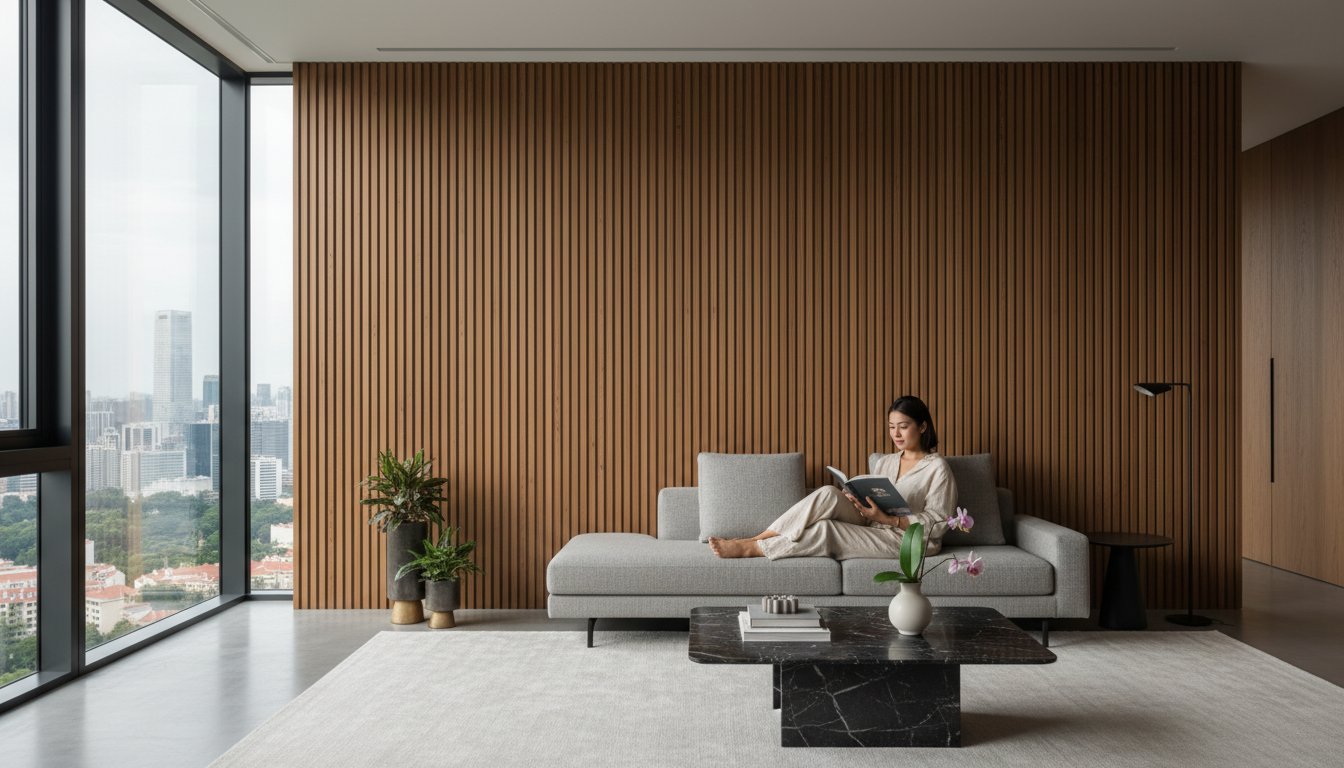
These 3D textured panels are the preferred choice for modern feature walls because they manage sound without the clinical look of industrial foam. They offer a stylish way to treat a room. Instead of absorbing every sound and making a space feel “dead,” fluted designs maintain a sense of life and clarity. It’s a professional-grade approach to acoustic management that fits perfectly into an elegant interior design scheme.
Diffusion vs. Reflection: A Visual Guide
Sound waves travel until they hit a surface. On a flat wall, they bounce back in a single direction, much like a ball hitting a smooth floor. Fluted grooves scatter these waves in multiple directions. This process, known as diffusion, prevents “standing waves” and flutter echoes. It makes a compact HDB living room feel larger and more acoustically balanced because the sound decays naturally. You’ll notice that voices sound clearer and music feels more immersive.
STC Ratings and What They Mean for Your Home
The Sound Transmission Class (STC) is a standard integer rating that measures how well a partition reduces airborne sound. In Singapore’s dense urban environment, understanding these numbers is vital for a peaceful home. A standard 12mm internal drywall usually has an STC of around 33. At this level, you can easily hear a loud conversation from the next room. To effectively block the sound of a loud television or a vacuum cleaner, you generally need a rating of 50 or higher.
Adding a layer of WPC (Wood Plastic Composite) fluted paneling to an existing wall typically provides an STC boost of 3 to 6 points. While this might seem like a small number, a 10-point increase is perceived by the human ear as a 50% reduction in noise. This makes wall paneling for sound insulation an elegant solution for homeowners seeking to enhance their privacy. It’s a premium upgrade that combines long-lasting performance with a flawless aesthetic, ensuring your home remains a quiet sanctuary.
Professional Implementation: Actionable Tips for Optimal Soundproofing
Achieving a flawless acoustic environment requires more than just choosing premium materials; it demands a strategic approach to installation. Many homeowners mistake decorative “islands” of panels for a complete soundproofing solution. While a few centered panels might reduce echo, they won’t stop sound transmission. For effective wall paneling for sound insulation, you should aim for full-wall coverage. Leaving even 10% of a wall surface exposed can allow up to 50% of the sound energy to leak through, undermining your investment in high-quality materials.
Decoupling is the secret to professional-grade results. This process involves creating a physical break between the existing wall and the new panels to stop vibrations. In Singapore’s high-density HDB flats and Condos, structural noise from neighbors often travels through shared concrete slabs. You can mitigate this by using 2mm to 5mm acoustic underlays or creating a small air gap between the panel and the wall. This “room within a room” effect ensures that sound waves lose energy before they can vibrate your interior surfaces.
Step-by-Step Selection and Placement Strategy
Start by identifying whether your noise issue is airborne, like a neighbor’s television, or impact-based, such as footsteps. This dictates your material density. We recommend a minimum of 25-30% wall coverage to notice a significant drop in decibel levels. If you’re treating a home office in a typical 12-square-meter HDB bedroom, focus first on the wall directly facing the noise source. Use a high-tack, low-vibration adhesive rather than heavy mechanical fastening. Screws can act as “acoustic bridges,” carrying sound vibrations directly from the panel into the wall studs.
The “Quiet Room” Checklist
Precision during the final stages of installation determines the longevity and performance of your acoustic setup. Even the most sophisticated wall paneling for sound insulation fails if air can pass through gaps. Small openings around electrical outlets or skirting boards act like holes in a bucket. Use acoustic sealants to plug these micro-leaks. For a total acoustic seal, combine your wall panels with specific types of vinyl flooring that feature integrated IXPE foam backings. This creates a continuous barrier from floor to ceiling.
- Seal every gap around power points with non-hardening acoustic caulk.
- Ensure fluted panels are aligned vertically to maximize sound diffusion across the room’s width.
- Install panels from the floor up, ensuring a tight fit against the skirting board to prevent flanking noise.
- Verify that the mounting system doesn’t compress the acoustic underlay, as compressed foam loses its dampening properties.
Professional soundproofing is a balance of aesthetics and physics. By treating the wall as a complete system rather than a series of individual panels, you create a sanctuary that is both stylish and serene. It’s about building a premium foundation that stands up to the rigors of urban living.
Elevating Your Space with Nature Living Floor Solutions
Nature Living Floor provides the perfect foundation for any space by merging technical performance with high-end aesthetics. Our premium WPC and SPC collections aren’t just about covering surfaces; they’re about creating a harmonious environment where every element works together. When you choose our wall paneling for sound insulation, you’re investing in a solution that balances acoustic control with visual elegance. The synergy between a well-insulated feature wall and resilient flooring is what transforms a standard room into a professional-grade sanctuary. By layering these materials, you create a dense barrier that effectively traps noise, preventing echoes from bouncing off hard surfaces.
Our Elegant Wall Solutions are designed to be the centerpiece of your interior design. We don’t believe you should have to choose between a quiet home and a beautiful one. These panels provide a sophisticated backdrop that complements our flooring ranges, ensuring a seamless flow from the ground up. Whether you’re designing a home cinema in a HDB flat or a private executive office, our materials deliver the modern refinement your project deserves.
The Nature Living Difference: Quality and Style
Our panels are specifically engineered to thrive in the Singaporean climate. High humidity levels often cause traditional timber to warp or rot, but our WPC and SPC solutions are 100% waterproof and termite-proof. This durability ensures your investment remains flawless for decades without the need for constant repairs. We offer two distinct aesthetic moods through our Winter and Summer collections. The Winter series features six cool, muted tones for a minimalist or industrial vibe, while the Summer collection brings eight warmer, organic textures that evoke a sense of natural comfort.
Maintenance is another area where our modern solutions shine. Unlike traditional acoustic foam or fabric panels that trap dust and allergens, our wall panels feature a non-porous surface. You don’t need specialized chemical cleaners; a simple wipe with a damp cloth is enough to maintain their premium appearance. This ease of care makes them an ideal choice for high-traffic areas or homes with children and pets.
Start Your Design Journey Today
Planning a renovation shouldn’t be a guessing game. Our Product Visualizer tool allows you to upload a photo of your actual room and instantly see how different textures and colors interact with your lighting and furniture. It’s a vital step in ensuring your wall paneling for sound insulation fits your vision before the installation begins. This tool helps you experiment with the contrast between our Winter and Summer palettes, giving you total confidence in your design choices.
For those who prefer a personalized touch, our consultants in Singapore, Klang, and Yangon offer expert guidance tailored to your specific architectural needs. They provide technical insights into how our premium materials can solve your unique acoustic challenges while staying within your budget. Take the first step toward a stunning masterpiece today. Explore our premium wall panel collections and discover how we combine beauty with long-lasting performance to create the ultimate interior experience.
Transforming Your Space into a Sophisticated Acoustic Sanctuary
Achieving quiet luxury in a dense urban environment like Singapore requires more than just aesthetic choices. Materials matter. Selecting premium wall paneling for sound insulation made from WPC or SPC materials provides a 25% to 35% reduction in ambient noise transmission compared to standard bare walls. These materials don’t just dampen sound; they serve as a flawless foundation for modern interior design. By combining fluted textures for acoustic diffusion with expert-led installation techniques, you ensure your living space remains both serene and stylish.
Nature Living Floor serves homeowners across Singapore, Malaysia, and Myanmar with high-performance solutions that combine beauty with long-lasting performance. Our expert team provides design-led guidance to help you select the right material density and fluted profiles for your specific room dimensions. Whether you’re upgrading a home office or a master suite, the right choice in paneling represents a smart investment in your property’s daily comfort. You’ll find that a well-designed room doesn’t just look better; it feels significantly more peaceful.
Discover Elegant Wall Solutions at Nature Living Floor
Start your journey toward a quieter, more sophisticated home today.
Frequently Asked Questions
Do wall panels actually help with sound insulation?
Yes, wall paneling for sound insulation effectively reduces noise transmission by adding density to your surfaces and breaking up flat planes that reflect sound. High-quality panels can lower ambient noise by 25 to 35 decibels depending on the material density and installation method. This creates a quieter environment by dampening vibrations that travel through common HDB or condo walls. For the best results, cover at least 30% of your room’s wall surface to notice a meaningful change in acoustics.
Which material is best for soundproofing a bedroom wall?
High-density Wood Plastic Composite (WPC) combined with an acoustic felt backing is the superior choice for bedroom soundproofing in Singapore. These materials often feature a Noise Reduction Coefficient (NRC) of 0.85 or higher, which means they absorb 85% of the sound that hits them. This combination blocks external chatter from the hallway while preventing echoes within the room. Choose panels with a thickness of at least 20mm for maximum performance in residential sleeping areas.
Can I install sound-insulating wall panels myself?
You can certainly install most modern wall paneling systems yourself using basic tools like a spirit level and industrial-strength adhesive. Many premium collections feature a tongue-and-groove interlocking system that ensures a seamless, professional finish without visible gaps. If you’re working with larger 2.4-meter panels, have a second person help you steady the material during the bonding process. For complex layouts around electrical sockets, a fine-tooth saw provides the clean edges needed for a flawless look.
What is the difference between sound absorbing and sound blocking panels?
Sound absorbing panels use porous materials like felt to stop echoes within a room, while sound blocking panels use heavy mass to prevent noise from entering through the wall. Most homeowners in Singapore require a hybrid solution to address both neighbor noise and internal acoustics. For instance, a dense WPC panel blocks the sound of a neighbor’s television, while its textured surface absorbs the bounce of noise inside your own living room. Combining these two functions provides the most sophisticated acoustic environment.
How much noise can I expect fluted wall panels to reduce?
Fluted wall panels typically reduce reflected sound by 15% to 20% by diffusing sound waves across their tiered surface. This design prevents the ping-pong effect of noise bouncing off flat, hard walls. While they aren’t a total soundproofing solution on their own, they’re excellent for improving speech clarity in home offices or dining areas. When paired with a 5mm acoustic underlay, their performance improves by an additional 10 decibels, making them a practical and stylish choice.
Are WPC wall panels moisture-resistant for tropical climates?
Premium WPC panels are 100% waterproof and specifically engineered to thrive in Singapore’s high humidity, which often averages above 80%. Unlike traditional timber, these solutions won’t warp, rot, or attract termites when exposed to moisture. This makes them a durable investment for any part of the home, including transition areas near bathrooms or balconies. You’ll enjoy long-lasting performance and a sophisticated aesthetic without the maintenance headaches associated with natural wood in tropical environments.
Do I need a special underlay for wall panels to block noise?
Using a 3mm to 5mm acoustic underlay or mass-loaded vinyl (MLV) behind your panels is highly recommended if your primary goal is blocking external noise. This extra layer adds the mass required to stop low-frequency vibrations, such as the hum of a nearby lift or heavy traffic. While the panels provide the aesthetic finish and mid-range absorption, the underlay acts as the heavy-duty barrier. This professional approach ensures your wall paneling for sound insulation reaches its full technical potential.
Will wall paneling for sound insulation increase my home value?
Professional wall paneling can increase a property’s perceived value by 3% to 5% by offering both aesthetic elegance and functional acoustic benefits. Prospective buyers in Singapore’s competitive real estate market often prioritize move-in ready homes with premium finishes and noise-reduction features. A well-installed feature wall serves as a stunning masterpiece that sets your unit apart from standard HDB or condo layouts. It’s a smart investment that combines immediate lifestyle improvements with long-term financial returns.
For those exploring what this level of quiet luxury looks like in a new development, you can learn more about properties designed from the ground up with serenity in mind.
Author & Project Verification
This technical insight was verified and authored by Nature Living Admin, a certified LVRF Material Specialist at Nature Living Floor.
Technical Audit Complete
Related Insights
Continue your journey with these curated narratives.