The Ultimate Guide to Fluted Wall Panel Feature Walls in 2026

Technical Editorial Director
AI Search Overview
What is it?
Discover The Ultimate Guide to Fluted Wall Panel Feature Walls in 2026 with Nature Living Floor. Expert insights on premium flooring solutions in Singapore.
Why it's important?
Understanding The Ultimate Guide to Fluted Wall Panel Feature Walls in 2026 is crucial for ensuring durable, waterproof, and aesthetically premium flooring installations in Singapore's humid climate.
Key Benefits
- Long-term durability
- High structural integrity
- Water & slip resistance
In 2026, a fluted wall panel feature wall is an architectural tool for manipulating light and shadow, not just a decorative surface. You likely agree that while the tactile appeal of timber is unmatched, the reality of maintaining real wood in Singapore’s tropical climate can be a major deterrent. You want a sophisticated, low-maintenance alternative that avoids the cheap look of common plastics while resisting local termite concerns. This guide promises to help you master the art of architectural texture by providing professional strategies for designing, specifying, and installing premium fluted solutions that last.
We’ll examine the technical differences between WPC and SPC materials, ensuring you select the right foundation for a flawless finish. You’ll also learn about the 2026 shift toward fine-pitch fluting profiles and how to verify quality using international standards like ASTM E84 for fire safety and E0 for formaldehyde emissions. Whether you’re budgeting for professional installation, which typically ranges from S$9.50 to S$34 per square foot, or selecting the perfect finish, these actionable tips will help you create a stunning masterpiece with confidence.
Key Takeaways
- Master the technical differences between WPC and SPC to select the most durable and stylish material for your specific environment.
- Apply the “Rule of Thirds” and integrated lighting techniques to transform a standard room into a sophisticated fluted wall panel feature wall.
- Learn the essential pre-installation checklist, including moisture testing and wall flatness standards, to ensure a flawless and long-lasting performance.
- Discover how “Snap-Panel” technology streamlines the installation process while achieving seamless, professional-grade woodwork joinery.
- Evaluate premium alternatives to real timber that offer high-end aesthetics without the maintenance challenges of Singapore’s tropical climate.
What is a Fluted Wall Panel Feature Wall? Defining Tactile Minimalism
Architectural fluting isn’t a modern invention; it dates back to the classical orders of Greek and Roman columns. By incorporating vertical grooves, ancient builders manipulated light to create a sense of grandeur and rhythm. Today, a fluted wall panel feature wall serves as a modern evolution of this technique, blending classical elegance with the clean lines of 2026 tactile minimalism. Exploring the history of wall paneling reveals that while the materials have evolved, the desire to add depth to flat surfaces remains constant.
In modern Singaporean homes, these panels act as the perfect foundation for any space by providing a sophisticated alternative to flat paint or wallpaper. The shift toward high-performance composites like WPC and SPC reflects a demand for “beauty meets long-lasting performance,” especially in humid tropical climates where traditional timber often fails. These modern solutions ensure your interior remains flawless without the risk of warping or termite damage.
To better understand how these panels transform a room, watch this helpful video:
The Anatomy of a Premium Fluted Panel
A premium panel is defined by its core. While solid wood offers authenticity, Wood Plastic Composite (WPC) provides a lighter, termite-resistant alternative that mimics the warmth of timber. Stone Plastic Composite (SPC) is the denser, more rigid choice; it’s ideal for high-traffic areas requiring maximum impact resistance. High-definition vinyl films now achieve a level of realism that makes it difficult to distinguish these composites from natural veneers. Architectural fluting is a deliberate tool for creating visual rhythm through the repetition of vertical shadows.
Why Texture is the New Colour in 2026
Design experts in 2026 are moving beyond flat colour palettes. Tactile walls provide a sensory experience that flat finishes can’t replicate, often increasing property value by signaling a higher tier of interior specification. Applying a fluted wall panel feature wall allows designers to manipulate light, as the repetitive vertical patterns have a documented psychological effect, fostering a sense of “calm” by guiding the eye upward. This verticality is especially effective in urban apartments, where it creates the illusion of height. In minimalist lounges, a single fluted section can define a zone without the need for bulky furniture. In contrast, executive suites utilize full-height fluting to convey authority and architectural permanence.
Material Science: Choosing Between WPC and SPC Wall Panels
Selecting the right core material for your fluted wall panel feature wall is the most critical decision in the design process. In Singapore’s tropical climate, where relative humidity levels often exceed 80%, traditional timber is prone to warping and moisture absorption. Modern composites solve these issues by engineering specific performance traits into the panel’s foundation. While Wood Plastic Composite (WPC) and Stone Plastic Composite (SPC) may look identical on the surface, their internal structures serve very different architectural purposes.
WPC: The Designer’s Choice for Living and Bedrooms
Wood Plastic Composite (WPC) is a sophisticated blend of recycled wood fibres and thermoplastics. It’s lighter than its stone-based counterparts, making it easier to handle during vertical installations. Designers prefer WPC for residential spaces because it retains a “warm” tactile feel similar to natural wood. This material excels in acoustic management; the cellular structure of the WPC core helps dampen sound reflections, which is ideal for home theatres or bedrooms. For a standard residential fluted wall panel feature wall, a profile width of 160mm to 200mm is recommended to balance visual rhythm with ease of maintenance. WPC typically costs between S$0.65 to S$2.00 more per square foot than SPC, reflecting its complex manufacturing process and superior thermal insulation properties.
SPC: Durability for Commercial and Wet Areas
Stone Plastic Composite (SPC) is the “heavyweight” of wall solutions. Composed of natural limestone powder and stabilizers, it’s incredibly dense and rigid. This density provides a level of impact resistance that WPC cannot match, making it the perfect choice for high-traffic corridors, office lobbies, or commercial spaces. SPC is virtually waterproof and dimensionally stable, meaning it won’t expand or contract significantly when exposed to temperature shifts. It’s the wall equivalent of premium flooring, offering a flawless finish that withstands the rigours of daily life. If you’re looking for a long-lasting investment, you can explore our elegant wall solutions to see how SPC cores provide a resilient foundation for modern interiors.
When comparing installation complexity, weight is the deciding factor. SPC panels are significantly heavier and require high-tack adhesives to ensure they remain secure on vertical surfaces. WPC panels are more forgiving on slightly uneven walls due to their inherent flexibility. Regardless of your choice, ensure your panels meet international safety standards. Look for an E0 formaldehyde emission rating (≤ 0.07 mg/m³) and ISO 9001 certification to guarantee that your feature wall is as safe as it is stylish. These technical specifications ensure that your design isn’t just a temporary trend, but a durable masterpiece that combines beauty with long-lasting performance.

Design Strategies for a Sophisticated Feature Wall
Designing a fluted wall panel feature wall requires an architectural mindset that moves beyond simple decoration. To achieve a professional finish, you should apply the “Rule of Thirds” to your wall proportions. Full-height installations, typically reaching 2.4m to 3m in Singaporean apartments, create a sense of vertical continuity and grandeur. If you prefer a more grounded, classic aesthetic, consider wainscoting applications that stop at the 900mm or 1200mm mark. This technique defines the room’s lower perimeter while leaving the upper wall for art or contrasting paint.
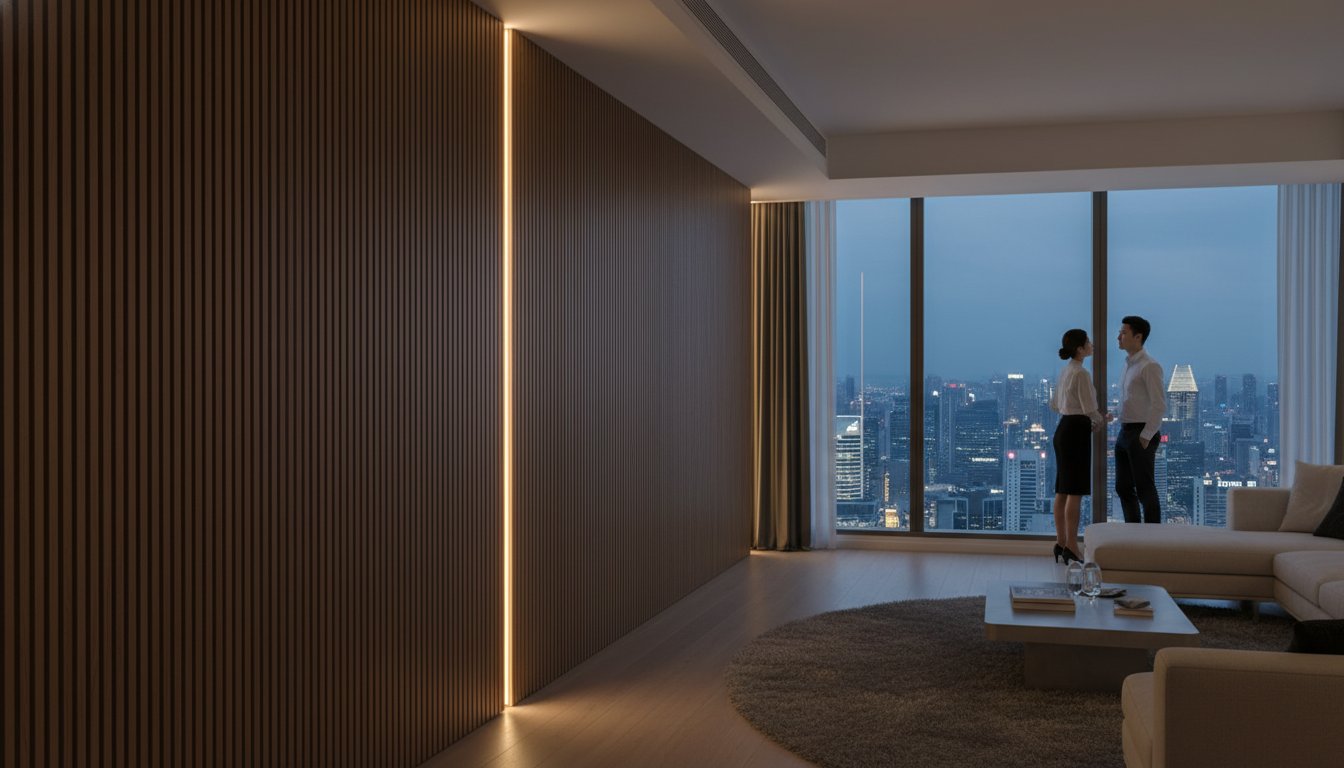
Lighting is the most overlooked element in panel design. To truly elevate the texture, integrate hidden LED strips at the top or base of the panels. This creates “grazing light,” where the beam runs parallel to the surface, deepening the shadows within the grooves and emphasizing the three-dimensional profile. For 2026, the trend moves toward organic sophistication, featuring palettes of earthy ochres, deep walnuts, and stone greys. You can create a stunning masterpiece by pairing these linear flutes with the fluid veining of marble-look LVRF, balancing rigid geometry with natural curves.
The TV Feature Wall: Balancing Tech and Texture
The television area is often the focal point of a home, yet it’s frequently cluttered by technology. You can use the hollow cavities inherent in WPC fluted profiles to hide unsightly power cables and HDMI leads, ensuring a clean, minimalist look. To improve your viewing experience, select panels with a matte finish. These surfaces can reduce screen glare by up to 45% compared to traditional high-gloss laminates. For a modern, “floating” effect, install backlit panelling that makes the TV unit appear to hover against a sea of shadow and light.
Commercial Elegance: Lounges and Reception Areas
In open-plan commercial environments, fluted textures serve as an elegant zoning tool. Instead of building heavy permanent partitions, use vertical panelling to define waiting areas or executive suites. To achieve a cohesive and professional brand identity, match your wall solutions with premium vinyl flooring. This creates a “total space” concept where the floor and walls work in harmony. Beyond aesthetics, the repetitive ridges of the flutes act as a natural sound diffuser. In meeting rooms, this reduces echo and improves speech clarity, providing a functional benefit that complements the stylish design.
Professional Specification and Installation Tips
Achieving a flawless fluted wall panel feature wall begins long before the first panel touches the surface. Professional installers prioritize a pre-installation checklist that includes verifying wall flatness and conducting moisture testing. In Singapore, where concrete walls can retain high humidity, ensuring the substrate is dry prevents future adhesive failure. A wall deviation of more than 3mm over a 2-meter span usually requires leveling to ensure the panels sit flush against the substrate.
‘Snap-Panel’ technology has revolutionized the industry by allowing for seamless woodwork joinery that hides all visible fasteners. This interlocking system creates a continuous rhythm without the gaps often seen in DIY attempts. For the best bond, professionals use high-tack MS polymers. These adhesives provide an immediate grab and remain flexible over time, accommodating the subtle thermal expansion common in tropical climates. To complete the look, you should incorporate aluminium trims for a modern edge or PVC skirtings to protect the base from moisture during floor cleaning.
Step-by-Step Installation for a Flawless Finish
- Measuring and cutting: Use a fine-tooth miter saw for WPC panels. For denser SPC cores, a diamond-tipped blade is necessary to prevent chipping the high-definition finish.
- The ‘first plank’ rule: Your entire project depends on the first panel. Use a laser level to ensure perfect vertical alignment; even a 1mm tilt at the base results in a significant lean by the end of the wall.
- Corner treatments: For a high-end architectural finish, use mitred edges cut at 45 degrees. If the wall isn’t perfectly square, dedicated L-profiles offer a clean, forgiving alternative.
Maintenance and Long-Term Care
Maintaining the sophisticated appeal of your feature wall is straightforward but requires specific techniques. Dust often settles in the deep-groove profiles; use a soft microfiber wand or a vacuum with a brush attachment once a week to keep the grooves clear. You’ll want to avoid abrasive chemicals or scouring pads that can scratch the protective vinyl film. Instead, use a damp cloth with a pH-neutral cleaner to wipe away fingerprints or smudges. Understanding different types of vinyl flooring helps in maintaining matching wall panels because both surfaces often share similar protective top layers and cleaning requirements. If you’re ready to transform your space into a stunning masterpiece, discover our premium wall solutions and start your project today.
The Nature Living Advantage: Elegant Wall Solutions
At Nature Living Floor, we believe that a fluted wall panel feature wall shouldn’t just be an aesthetic afterthought. It serves as the perfect foundation for any space, setting the stage for a lifestyle defined by modern refinement and dependable quality. Our commitment to the principle that “beauty meets long-lasting performance” ensures that every panel we provide is engineered to withstand the specific humidity and temperature challenges of Southeast Asian environments. Whether you’re designing a high-end condominium in Singapore or a sprawling residence in Klang, our solutions offer a sophisticated, tactile aesthetic that doesn’t compromise on structural integrity.
We prioritize expert-led specification by offering eco-friendly WPC and SPC options that meet rigorous E0 formaldehyde emission standards and ISO 14001 environmental management certifications. This focus on health and sustainability means your interior remains safe for your family while looking like a stunning masterpiece. Our panels are more than just building materials; they’re foundational elements of a stylish lifestyle. By selecting our premium composites, you’re choosing a low-maintenance alternative to wood that resists termites and warping, ensuring your investment remains flawless for years to come.
Complete Your Space with Matching Accessories
A professional-grade finish depends on the subtle details that bridge the gap between different surfaces. We provide a curated range of PVC skirtings and aluminium trims designed to complement our wall solutions perfectly. These accessories prevent the “unfinished” look often found in lower-quality installations and provide a clean transition between your wall and floor. To make the design process more intuitive, our ‘Winter’ and ‘Summer’ collections simplify colour matching by grouping complementary tones and textures. You can Discover our Elegant Wall Solutions to see how these matching elements create a cohesive, polished environment that reflects your personal style.
Start Your Project with a Design Expert
You don’t have to guess how a specific texture will look in your home. Use the Nature Living Floor Product Visualizer to see our collections in a digital environment before you commit to a purchase. We also highly recommend requesting physical samples to test how the architectural fluting interacts with the actual light in your space. Light shifts throughout the day, and seeing the shadow play in person is the only way to guarantee a result that meets your expectations. If you need personalized advice, visit our showrooms in Singapore or Klang for a consultation with a design-savvy expert. We’ll guide you through the material selection and finishing process, ensuring your fluted wall panel feature wall is a smart, reliable investment that completes your space beautifully.
Design Your Future with Architectural Precision
Creating a sophisticated fluted wall panel feature wall is an investment in both your property’s value and your daily sensory experience. You’ve learned that the secret to a high-end finish lies in the balance between material science and architectural lighting. By choosing between WPC and SPC cores based on your room’s traffic and moisture levels, you ensure your design remains resilient against the tropical climate. It’s the small details, like using professional-grade finishing accessories and precise vertical alignment, that elevate a simple renovation into a stunning masterpiece.
Nature Living Floor is here to act as your trusted advisor throughout this creative process. Our team provides the expert guidance you need to select materials that are both waterproof and termite-proof, ensuring your home remains a sanctuary of style. We offer the perfect foundation for any space, combining modern aesthetics with dependable quality. Transform your space with our premium Fluted Wall Panels and discover how tactile minimalism can redefine your interior. Your vision for a flawless, elegant home is now within reach.
Frequently Asked Questions
Are fluted wall panels termite-proof?
Yes, composite fluted wall panels are inherently termite-proof because they don’t contain the organic cellulose found in raw timber. Unlike traditional wood, WPC and SPC materials don’t attract pests, making them a premium choice for tropical environments. This durability ensures your fluted wall panel feature wall remains structurally sound and visually flawless for decades without the need for chemical treatments or frequent replacements.
Can I install fluted panels in a bathroom or wet area?
You can install fluted panels in bathrooms provided you select Stone Plastic Composite (SPC) variants. SPC is 100% waterproof and dimensionally stable, meaning it won’t swell or warp when exposed to high humidity or direct water contact. Ensure you use a high-tack MS polymer adhesive and seal the edges with silicone to prevent water from seeping behind the panels and compromising the wall substrate.
How do I clean the dust out of the grooves in fluted panels?
The most efficient way to remove dust from vertical grooves is using a soft microfiber duster or a vacuum cleaner with a brush attachment. For deeper cleaning, a damp cloth with a pH-neutral solution is sufficient to remove fingerprints without damaging the high-definition vinyl film. Avoid using abrasive scouring pads or harsh chemicals, as these can dull the sophisticated finish of your feature wall over time.
What is the difference between WPC and SPC fluted panels?
WPC panels consist of wood fibers and thermoplastics, offering a warmer feel and better acoustic dampening, while SPC uses limestone powder for maximum rigidity. WPC is lighter and easier to install on standard interior walls, whereas SPC provides superior impact resistance for high-traffic commercial zones. Both options offer a stylish, low-maintenance alternative to wood, but SPC is the preferred choice for areas prone to moisture.
Can fluted panels be installed over existing wallpaper or tiles?
You must remove existing wallpaper before installation, but you can install panels directly over tiles using a high-tack adhesive. Wallpaper creates an unstable surface that can peel under the weight of the panels, leading to failure. For tiled surfaces, ensure the area is clean and free of grease; applying a primer can further enhance the bond of the adhesive for a permanent, professional-grade finish.
Are these panels fire-rated for commercial use?
Most premium composite panels are fire-rated and meet international standards like ASTM E84 Class A or B. These classifications measure surface burning characteristics, making them suitable for commercial and public spaces where strict building codes apply. Always verify the specific fire safety certificate of your chosen product series to ensure it complies with the latest Singapore Civil Defence Force (SCDF) regulations for interior finishes.
Do fluted wall panels help with soundproofing?
Fluted panels improve a room’s acoustics by diffusing sound waves, though they don’t provide total soundproofing. The repetitive vertical ridges break up flat surfaces, significantly reducing echo and reverberation in open-plan lounges or home theaters. WPC cores are particularly effective for this purpose due to their cellular structure, which absorbs more sound energy than denser materials like stone or ceramic tiles.
How much does a fluted panel feature wall cost in 2026?
In 2026, the total project cost for a fluted wall panel feature wall typically ranges from S$9.50 to S$34 per square foot. This includes professional installation labor, which averages S$4 to S$13.50 per square foot based on industry data from March 2026. Material prices vary by core type, with real wood panels costing between S$27 and S$68 per square foot, while high-performance composites remain a more budget-friendly yet premium-looking solution.
Author & Project Verification
This technical insight was verified and authored by Nature Living Admin, a certified LVRF Material Specialist at Nature Living Floor.
Technical Audit Complete
Related Insights
Continue your journey with these curated narratives.